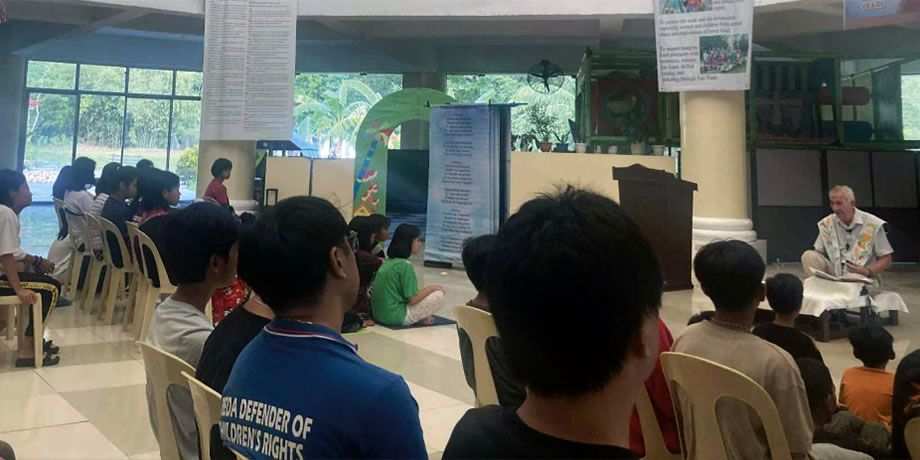
For the past six years, I have overseen the Year of Spiritual Formation for the Columban seminarians in Manila, Philippines. During the winter break of 2023, together with the students, I visited the PREDA Center in Olongapo, northern Philippines. PREDA stands for People’s Recovery, Empowerment and Development Assistance.
This center carries out various ministries. One of its ministries is running a shelter for boys and girls under twenty who have suffered physical violence or sexual abuse. In many cases, the perpetrators are their own fathers, relatives, or people from their neighborhood. Fr. Shay Cullen, a Columban missionary, first founded this center in 1974 to protect and heal such children, and it continues to function effectively to this day.

The center operates separate shelters for boys and girls. We first visited the shelter for girls, where about forty children were being cared for and protected.
After giving us a thirty-minute introduction about the shelter, Fr. Cullen guided us to the emotional therapy room on the second floor. When we entered, I saw that the room was about 33 square meters in size, with thick mattresses covering the floor. The walls and ceiling were lined with sound-absorbing materials, designed to keep all sounds from escaping. It felt as though no matter how much one shouted inside, no one outside could hear.
Fr. Cullen explained that once a week, with the help of professional counselors, the children are encouraged to express openly their feelings about the sexual and physical abuse they have suffered. During these sessions, the children sometimes scream, cry, pull their hair, or hit the walls with their fists or feet.
After releasing their anger and pain in such an active way, they gradually begin to talk about what happened to them and start sharing their traumatic experiences little by little.
Of course, accompanying them through that process is extremely painful and difficult to watch, but Fr. Cullen said that it is the first and most essential step toward true healing— and that is why he chooses to stay and be present in those moments.
When Jesus said, “Love your enemies,” and taught us to do good to those who hate, curse, or mistreat us, He was, in a sense, inviting us to recognize that even perpetrators may once have been victims.
He also said that for these children to fully lay down the immense pain and trauma they have endured, it may take an entire lifetime.
After hearing his explanation, I walked slowly along the walls of the therapy room and closed my eyes. Then, in my mind, I could almost hear the cries of the children, see their faces twisted in anguish, pounding the walls and the floor with their fists. The images struck my heart vividly, and tears welled up in my eyes. An overwhelming wave of anger and sorrow surged within me.
Unable to stay inside any longer, I stepped outside. There, in the courtyard, I saw the girls dancing joyfully to some music.
They looked just like any other children you might see anywhere— laughing, clapping, teasing one another when someone made a mistake. Watching them, my heart grew heavy and conflicted. It was hard to imagine that these same smiling, lovely children, when they entered the therapy room, would release such deep wounds, fears, and anger.
After visiting both the boys’ and girls’ shelters, we gathered for a time of reflection and prayer before going to bed. But that night, I could not sleep. My heart felt heavy, and my mind kept returning to what I had seen in the emotional therapy room—the children’s cries, the pain they released, the suffering they had endured.
As I stayed with those thoughts, I began to see not only the wounded children but also their families, relatives, and acquaintances connected to them. I realized that many of these perpetrators were themselves also victims—people who had once suffered similar abuse as children from their own parents or others.
Then I was struck by the horror of it: a cycle of evil perpetuated through generations, passed down to the most vulnerable—young girls and boys who bear the consequences of unhealed wounds.
When Jesus said, “Love your enemies,” and taught us to do good to those who hate, curse, or mistreat us, He was, in a sense, inviting us to recognize that even perpetrators may once have been victims. A victim whose wounds are never healed can later become a perpetrator.
After releasing their anger and pain in such an active way, they gradually begin to talk about what happened to them and start sharing their traumatic experiences little by little.
In this sense, when Jesus said, “Be merciful, just as your Father is merciful,” it was not only a call to compassion but also a warning about the continuity of sin—and an invitation to break that destructive cycle.
Of course, the horrific acts committed by the abusers against these children must never be hidden or ignored. On the contrary, the wounds of the victims must be continually voiced, and we must all weep together with them. Society must never demand forgiveness from these children who have endured such tremendous suffering. For this reason, I believe that the cries and screams of the children in the therapy room are actually the first courageous and sacred step toward breaking that chain of evil passed down through generations.
To listen to those cries without turning away, to stay with them until the end, and to help bring their pain to light in the community—I realized how deeply valuable such acts are.
The Church is not meant for the powerful or the privileged. It is for the weak, the wounded, and the poor. We must create a Church where their cries and their struggles are heard ever more loudly and more widely. Only then will the destructive continuity of evil lose its power.
Some people may feel uncomfortable exposing the dark corners of society, thinking that it only makes things worse. But truth-seeking must go hand in hand with justice and mercy. These three together—truth, justice, and mercy—are the key to building true peace. Justice or mercy without truth only leads to false peace.
In reality, truth does not provoke revenge but instead leads to reconciliation and forgiveness. Therefore, true forgiveness does not mean forgetting.
Of course, when we confront our wounds—the truth of our pain—it can bring greater suffering and conflict, just as the children in the therapy room cry out wildly when they face their trauma. But healing requires that we first recognize ourselves as wounded and from that awareness arises a deep longing for wholeness.
That longing is born only when we look directly at our pain and allow ourselves to grieve it. We must be able to cry out, “I am hurt.” Or “I am in pain.” Silence and avoidance do not help.
Therefore, we must acknowledge that conflict is an inevitable part of true forgiveness, and we must endure it. Only when we face that conflict fully can we take the first step toward genuine healing.
Columban Fr. Taemoon Kwon lives and works in South Korea.
