I recently finished as pastor of St. Mary’s Church in Fontana, California, after thirteen years. t was a great experience for me with 93% of the people there being Hispanic, different generations, from different Spanish-speaking countries, and different backgrounds. I loved it. I was interested when some people from our “Amor y Fe” (Love and Faith) ministry came to me and said they had contact with some Sisters from Colombia who worked in Guatemala. The Sisters were asking for some of us from the U.S. to come down to visit them. I know there are a number of people from Guatemala in the U.S. doing the dirty, dangerous, difficult jobs that Americans don’t really want to do, so I thought we could go down to see the other side of the migration issue —those left behind while their loved onesfind work to support their families back home.
 The Sisters are a team of three working in the town of Livingston on the East Coast. One is a pharmacist, the nearest thing they have to a doctor for many miles around. One is a catechist working with thousands of people, children and adults, and the other works with the dozens of parish groups. They told us the parishioners are Garifuna (descendants of African slaves from the 1600s who still speak their own language), Spanish-speaking mestizos, and people who belong to one of the many Mayan groups very common in Guatemala, who also speak their own language.
We didn’t want to go empty-handed, so we raised money at St. Mary’s by selling tacos and asking for donations. It was, after all, a "parish mission." Our people were very generous, some donating $100. We raised about $15,000 for this trip. Seven of us went as representatives of St. Mary’s, paying our own way. We used the money collected to rent a van from the capital to the coast, a six-hour drive, then to buy hundreds of pounds of rice, beans, sugar, flour, powdered milk, toilet paper, and many other things. We distributed these items to 400 families in four areas. What a job to repack everything into smaller bags, about 30 pounds each! It took a whole day with about 15 people sweating profusely.
After a welcoming Mass using all three languages, with the local Guatemalan pastor and a full church, we distributed 180 bags to those who were in most need in the town — elderly, handicapped, women with children, etc., at the church. Then we packed a truck and headed for the pier to take a boat across a bay and up a river to the first of the Mayan villages.
For me, it was a beautiful experience of meeting people who were not really “poor” but rather living very “simply.”
We did this three times during our days there. Beautiful bay and river with steep forests on both sides. People from the villages met us and helped carry our supplies to their villages in the woods. There were lots of women and beautiful children.
One of the Sisters explained in Spanish who we were and why we came, which was just to say “we see you and know you are our brothers and sisters forming one body of Christ, the Mystical Body.”
I also greeted everyone in the name of St. Mary’s Parish in Spanish. A local person interpreted into the local language for us. The children sang songs and a member of each family came to receive two bags of the things we brought. Then we had some rooster soup and tortillas that the women had prepared for us in the communal kitchens. We sat around, talked a while, and left.
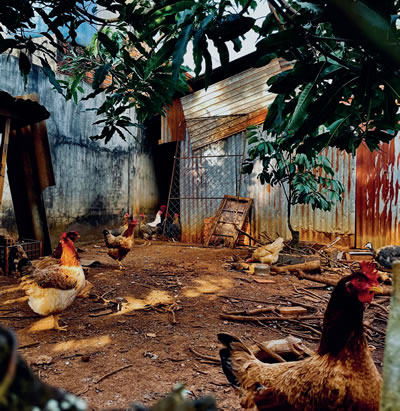
For me, it was a beautiful experience of meeting people who were not really “poor” but rather living very “simply.” They have village plots of slash-and-burn corn as their staple and chickens running around everywhere. There are no roads to their plots, so they walk great distances and use boats to get to the town. However, they need money to buy gas and pay for simple needs so often the men have to leave to find paying work. If the work is in the U.S., the paperwork is very complicated and takes years to get a visa if they can even get the visa. The education level is very low so they need someone, a lawyer, to help them, which is very costly and difficult. So, these are some of the “criminals” who come here without papers.
I don’t have the solution, but it is worth asking the question: “What would Jesus do?” As His disciples, all we can do is respond: “Lord, I will go with you.”
It breaks my heart to see them treated so poorly. The legal process is just too complicated and costly and time-consuming. They feel they have no other options.
I write this little article of my experience so that our readers might be able to put a personal, human face on those who come to the U.S. without papers. They are simple, good people who just want to provide for their family, where money is so scarce. Our immigration system is very difficult to maneuver in, and inefficient. It is broken and needs to be redone in an understanding, humane way that works for everybody. I don’t have the solution, but it is worth asking the question: “What would Jesus do?” As His disciples, all we can do is respond: “Lord, I will go with you.” Jesus sees people before He sees “criminals” or “sinners.” We must do the same.
Fr. Al was ordained in 1983, spent 20 years in Korea, 13 years in Fontana, California, and is now Regional Director in Omaha, Neb.
